
Contrast Enhanced Biopsy
A contrast biopsy can be ordered for many reasons but ultimately your radiologist needs a better view of a suspicious area in your breast tissue.
Contrast enhanced biopsy is like other biopsy procedures in many ways. A biopsy allows your doctor to locate and take a sample of a small or subtle area that appeared irregular on your contrast enhanced mammogram. Your physician will collect a sample of breast tissue for testing following an IV injection of an iodinated dye called a contrast agent. The experience is similar to a contrast enhanced mammogram or MRI that you may have had performed previously. The dye flows into your breast tissue and draws attention to areas of interest just like a highlighter marker emphasizes a specific word or sentence on a page. This allows your physician to better identify and target the lesion of interest during the procedure.
What to Expect with your Contrast Enhanced Biopsy
The Contrast Enhanced Biopsy procedure is simple, safe and requires little recovery time with minimal scarring to the breast. Local anesthesia is given to the skin and deeper breast tissue. After the anesthesia, a small incision is made to introduce the sampling needle. Using a gentle vacuuming technique, the radiologist removes tissue samples, which are sent for evaluation by the pathologist.
After the procedure is completed, stitches are not necessary. Steri-strips are placed on the tiny skin incision and after care instructions are given to the patient. The patient will then return to our office the next day for the physician to check the biopsy site and discuss the results.
How to Prepare:
BEFORE THE EXAM
- Wear loose clothing for comfort and do not wear deodorant.
- Most patients are able to eat and drink normally and perform their typical daily activities before arriving for their breast biopsy.
DURING YOUR PROCEDURE
- First, an IV will be inserted into your arm to administer the iodine contrast agent.
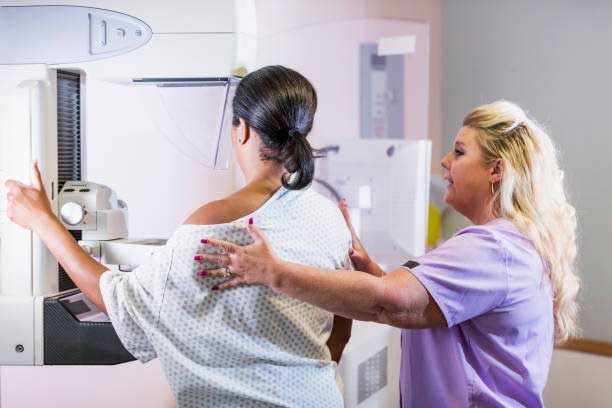
- Next, the technologist will position you at the mammography machine. Your breast will be compressed while images are taken so your physician can identify the exact location of the area to biopsy.
- The technologist will clean your skin with sterilizing solution and the physician will numb the area with anesthetic.
- The physician will make a small incision and the needle will enter the breast. The physicians may take several samples of tissue for evaluation.
- The tissue sample will be sent to pathology for evaluation. Your physician will let you know when results will be available, and your provider will contact you.
- A final set of images may be taken to verify that the appropriate tissue was collected.
AFTER YOUR PROCEDURE
- A small bandage will be placed over the incision, and you may be given an ice pack to apply to the biopsy site.
- In some instances, a compression wrap bandage may be placed around your chest to minimize chances of swelling or bruising.
- Follow your physician’s directives, but it is likely you can return to your normal daily activities.